Showing posts with label Chickens. Show all posts

Monday, December 28, 2020

Carl’s Comb

 Carl started crowing last night around 3am and woke us from a sound sleep. You might wonder why on earth we could hear our rooster in the middle of the night and you would be right to do so. It’s because he is currently housed in a kennel in the utility room. 

Yesterday when I went out to release the chickens there was blood sprayed around inside the coop. Not death quantities, just spatter. The last time that happened Bunty had torn her comb and sprayed blood whenever she shook her head. So I immediately started checking everyone for damage. Sure enough Carl’s comb was torn. Now how on earth he did it is a mystery. 

Chickens have an amazing ability to catch themselves on stuff. When Bunty was injured I decided it was a metal band that I was using to attach the grit cup to the wall. I removed it and no other injuries occurred so I figured I was right. So what was in there that Carl could get caught on? Given the size of his comb I decided it was the mouth of the feed tube. It’s PVC, not sharp, but if he got his head inside the Y joint it’s possible he pulled hard enough to tear the comb where it attaches to the top of his head (no, I’m not posting pictures. Ick). 

The damage isn’t severe but it is enough to make him shake his head and spray blood. It’s also enough to attract the other chickens and they were making it worse by pecking at him. Obviously he needed to be isolated. Chris easily caught him (an indication of his needing help as he doesn’t usually like to be touched) and we cleaned him up, put him in the medium kennel with all the comforts of home, and placed him in the utility room where he’d be warm and quiet. A towel draped over the kennel helped to settle him also.

And he’s definitely feeling better because he’s crowing up a storm. At 3am, of course. He’s also eating, drinking, and the blood is no longer dripping. We’ll keep him isolated for another day, treat him with that goop that turns blood black (to keep the girls from pecking him), and put him back in the coop at nightfall. Everything should be okay when they wake up the next morning.

Oh, and I removed the feed tube and replaced it with a heavy crock. I’ll need to keep a closer eye on it to make sure it doesn’t get soiled or spilled, but hopefully that will solve the problem.

Wednesday, December 16, 2020

Chicken Update


Egg!
In late October the older hens went into molt and halted egg production. Completely normal, nothing to worry about. And the younger hens were still laying 3 to 4 eggs per day from 5 hens. 

The molt was going on a bit long and as the days got shorter the younger hens decided an egg moratorium was a good idea. Huh? This is flock #3 for me and every other young flock laid consistently throughout the winter without needing supplemental light. This flock figured a break was a great idea and quit laying a full two weeks before Thanksgiving.

I had to buy eggs! I own 10 hens! I was a wee bit upset.

So I decided to add a light on a timer inside the coop. I had a bulb cage, an outlet in the coop for the water heater, and a good place to hang the cage where it wouldn’t get knocked down. A bit of research said they needed at least 14 hours of light and that you should introduce it gradually. And that’s what I did. I extended the day in both directions by a half hour until I had at least 15 hours of light (I figured better safe than eggless). 

It took a while for them to start again, but I’m now getting 3 to 4 eggs a day. They started December 7 and haven’t missed a day since. 

The older hens are finally out of molt and laying (that’s a Bunty egg up there. The super extra large that looks like a goose got into the coop) although I don’t expect daily production from them. Two of the younger birds are consistent layers but the other three are sporadic. I think I’ll need to put bands on everybody so I can start figuring out who is laying and who needs culling. But that’s a problem for nicer weather. It’s 4 degrees out and I’m just happy they’re laying at all.

Tuesday, September 8, 2020

So many eggs!

Remember those itty-bitty chicks I got in the Spring? They’re all grown up and laying already. They started laying way earlier than any chickens I’ve had before too. I expected to start getting eggs haphazardly starting at 25 weeks-which is two weeks away. Instead they’re laying frequently and I’m getting good sizes most of the time. Of course they are pullets so I find tiny eggs too!

That’s a cherry tomato for scale

Compared to a Bunty egg

Bunty laid a double-yolker 

So many eggs!
So I now have 10 hens laying almost daily. That’s a lot of eggs for two people. So what do I do with all those eggs? Mostly we scramble them for breakfast but I’ve been trying some new recipes too.

Scotch eggs!

Fresh pasta

Cherry tomato sauce on handkerchiefs

Of course there are lots of frittatas, quiches, cakes, and what-not. I think challah is coming soon too.
 

Tuesday, July 21, 2020

Carl the Randy Rooster

This is my third flock of chickens, but my first experience with a rooster. I had no idea the shenanigans he would get up to. Nor did I know how quickly he’d start them.
The culprit 
He’s only 15 weeks old. 15! And yet he’s already grabbing the girls neck feathers and trying to mount them. They, also being only 15 weeks old, want no part of this. So they scream. Loudly. The first time I thought a fox had got one. Nope; just Carl.

Oddly, he makes zero effort to woo the older hens that would be all too willing to entertain a strong young stud. At least I assume they’d be willing as they squat and quiver at the least encouragement. Basically, wave a hand over one and she’ll assume the position. Maybe they intimidate him?

I’ve requested a Storey’s book on chicken raising from my library. Hopefully it’ll provide some insights.

Wednesday, July 1, 2020

A Tale of Two Flocks

The big day. A day of portent. A day of trepidation. A day that was surprisingly anticlimactic.

Shortly after Carl announced the coming sunrise (he misses by a good 20 minutes each day. And he’s always early), I scooted up to the coop to let out all the birds. I’d put up a divider and netting so that the old flock could see the new girls but no one could actually interact. That was a full month ago and it was finally time to merge the groups.

I’d done a bit of reading and several people suggested having a good distraction when the two flocks first meet. I figured sunflower seeds would work and scattered a generous helping around the pasture in front of the gate.
Enjoying a feast
It worked well. They all ate and pretty much ignored each other. At least until Carl (barred rock) met Tso (small black sex-linked). A wee bit of chest bumping and Carl retreated. 

Carl and Tso face off
A few more scuffles as the seeds disappeared and then everyone went their own way.
Just before spreading out
Really, it was super calm. Bunty chased a few pullets around the pasture but everyone else just got on with chicken stuff. 

I kept an eye on them throughout the day, letting the old flock out of the pasture to free range while keeping the youngsters inside; closing the oldsters back in so they could get to the nest boxes; just making sure everything was okay. And eventually watching everyone go in to roost at night. The babies are still sitting on the interior pop door stoop rather than using roosts which only matters as that totally blocks the door. Bunty had to force her way through them to get to the roost. Chickens scattering everywhere! Inside! Off the ladder! But it calmed back down, the other ladies made it inside, and all is secured for the night. 

We’ll see how they all do in the morning. I’ve left a bowl of food out in the run and the feed tube in the coop is full as well so they’ll have multiple places to break their fast. Hopefully that’ll keep things calm until I get out there to open up the exterior pop door. 

Monday, June 22, 2020

And back to hot! A general update.

Well, summer hit hard last week. Lots of temps in the upper 80s. The garden is loving the heat but isn’t so happy about the complete absence of rain. It’s a bit disturbing how dry we are so early in the summer. The catchment basin, which normally holds water until mid-August, is almost totally dry. More a stinky mud pit than a shallow pond. I doubt the wood frogs had a chance to develop from tadpoles, poor things.

Chris did a hive check on the new bees and all appears well. He’s got capped cells in the frames and they are actively working all day. My tomatillos are starting to flower and the last bees adored them. Hopefully these guys will like them too as I purposely planted three near the hive.

The wee chicks are 11 weeks old and running around the fruit pasture like crazy things. The older flock is paying more attention to them through the fencing and I’m going to try to integrate them next week. As this is my first time combining flocks I’m more than a bit nervous. 

Chris continues to make great progress on the upstairs railing. We’ve poured black colored resin into the cracks and voids in the two cherry newel posts, stained the middle pine posts black, and stained all the panel wood black as well. The bottom support rail is in ash and we’ve burned it like the dining room table top (which I just realized I never posted about). We’ll do the same to the ash rail cap. He’s got to cut the goat panel to size, I’ll paint it, then it’s on to assembly. 

NY is now in phase 3 reopening although most the rest of the country continues to see rising COVID-19 cases. Hopefully we continue our favorable trend. Our favorite restaurant is reopening this week and we’ve decided it’s time to venture out. We’ll use only the outdoor seating and hope for the best.

Dad has spent the last two weeks in South Carolina getting his new house prepped for his moving in. His house up here closes soon and I’ll be heading south to help him get settled. We’ll definitely miss having him so close but I totally understand the desire to get away from our hard winters.


working on the railing 

Monday, June 1, 2020

Venturing out

With the garden pasture complete I can now easily lock the big chickens out of the fruit pasture. Which means I can let the chicks out to explore without worrying about them being harassed. I won’t be integrating the flocks for many weeks yet but this gives yet another opportunity for the flocks to safely see each other.

The first out was the barred rock. She wasted no time leaving the run and coming to see what I was doing.

What’s up?
Then she called the others.
Check this out!
A few pecks on the ground...
Hmmm, tasty.
And everybody came running.

Stampede!
I stayed nearby to keep an eye on things (cats, dogs, chickens, hawks, oh my) and they had a grand time exploring and tasting everything they could reach. After about 20 minutes they opted to settle down back in the run and I closed the pop door. 

A very successful first excursion.


Wednesday, May 20, 2020

Garden update

Tuesday weather was fantastic, especially for working outside. Sunny, cool breeze, temps in the low 70s. Wonderful!

I transplanted the cabbage, kohlrabi, tomatillos, bachelor buttons, nasturtiums, and marigolds. The sunflowers are ready but I’m not...need to finish the fence so I can plant them at the base of the posts. I also direct sowed my herb seeds as well as carrots, cucumbers, and zucchini. I still have cuke and zuke starts but they need more time to grow before I put them out. 

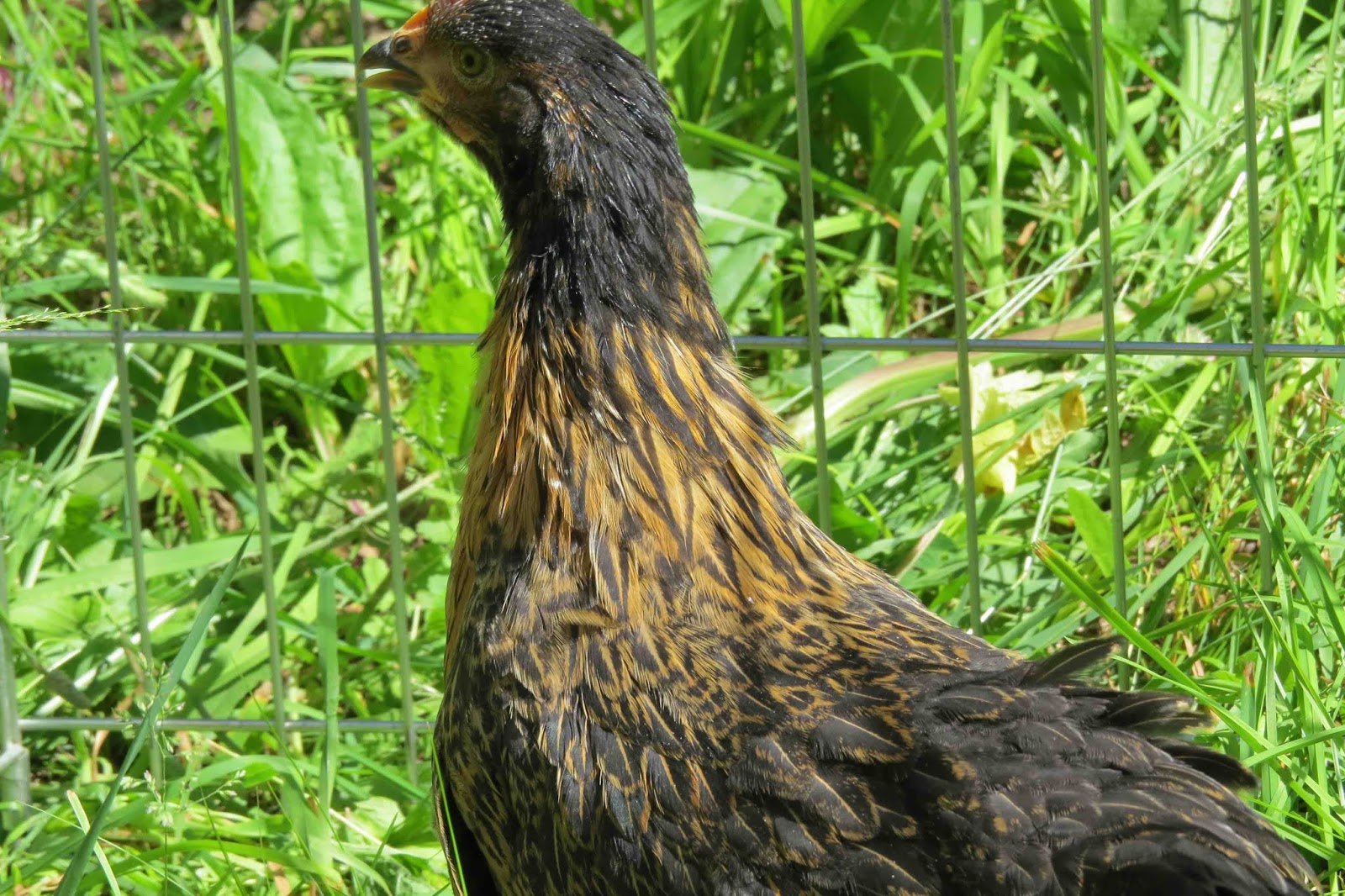
The chicks are growing well. They are now 7 weeks old and getting brave. They’re venturing into the closed run now and are able to get up and down the ladder okay. Their coloration is pretty and I think the Black Sex-links are going to more closely resemble Bunty rather than Tso. The Barred Rock of course stands out as it’s the only one of those I have. Still not sure if it’s a hen or roo. 

Look at that red head!

Watching the big chickens 
They’ve also started trying to fly out of their coop playpen. Which is bad as the big chickens live in the other side of that coop. I’ve put up soft fencing to keep them in but it’s obvious that it’s just going to get worse as they get older. Time to figure out how to handle accommodations until they’re big enough to integrate at about 14 weeks.

Thursday, May 14, 2020

I spent 6 hours shoveling chicken shit and had a great day

How’s that for a blog title?

Today was gorgeous-sunny, breezy, slightly cool. The perfect day to completely clean out the chicken coop and run after a long winter of deep-littering. The bonus would be being able to move the chicks out of the house (finally) and into the coop.

So I spent about six hours shoveling poop-heavy hay and debris out of the coop and run. It was hot work and I wore my homemade mask. It worked a treat. By the end of the day I was filthy and tired. But I was also deeply content. It had been a productive and quiet day. The chickens kept me company. The dog and cats checked in frequently. I had to shower before making and eating lunch with the full realization that I was just going to get dirty all over again.

Sitting and enjoying a cold drink after cleaning up for the final time, I realized that attitude makes all the difference. This could, literally, have been a shitty day.

Instead it was wonderful.

Saturday, May 9, 2020

This is becoming ridiculous

May 7th
May 9th
What’s with this weather? Last year I’d already planted a bunch of stuff in the garden. This year we’re getting snow?!? And it’s supposed to be freezing temperatures all week. Ick.
“Only” a couple inches
Crazy
When freezing temperatures hit late April I put the chicken water heater back in the coop as their outside water was freezing each night. Good thing I hadn’t gotten around to removing it yet.

Also, I still have chicks in my house. That’s right! They are nearly 5 weeks old and I really, really want them out in the coop but it’s just still too cold. Articles warn that they can’t take cold temperatures until they are fully feathered, including the neck feathers. Most look good but the barred rock is still fluffy in places so they’re still enjoying a heat lamp over the pen. I can do that much more safely in the house than I can in the coop. Plus the house is simply warmer.

So, to sum up: snow on the ground, a week of freezing temperatures ahead, chicks in the house, and a water heater in the coop.

I’m going back to bed.


Thursday, April 16, 2020

Silly birds

The chicks are growing like weeds. We moved them into the utility room when we realized it was too cold in the greenhouse at night despite having the heat lamp. This works fine and I’m quite surprised that the cats have completely ignored them.

They have taken to getting on top of the food and water containers. They perch up there like Snoopy on his dog house. I think it’s time to add a mini roost in there.


Tuesday, April 7, 2020

Chicks

Impossible to see chicks

My chicks arrived on the homestead yesterday. 5 Black Sex-Linked females and 1 mystery sex Barred Rock. I’ve had great success with the two BSL that are part of my current flock. They are hardy and consistent layers of extra-large brown eggs.

Originally I was going to get all Barred Rock for my replacement flock but since I liked the BSL so much and since the Barred Rocks being offered were straight run (meaning they weren’t sexed) I figured why take the chance I’d end up with roosters. BSL it was.

I did get 1 Barred Rock though and I’m about 50/50 as to whether I hope it’s a rooster. They can be wonderfully helpful in protecting the flock by keeping an eye out for predators. They can also be anti-social shits. Only time will tell which we get.

In case you’re wondering why I need a replacement flock, these are aging out. They were barely productive over the winter and I basically fed them with no return. The two BSL were my only consistent layers and even they were only laying a couple eggs per week each. So I’ll cull the Orpingtons this fall as they are the least productive and the most fragile health-wise. I’m getting excellent production right now and that should continue until they go into molt. Based on last year that will be just in time for an Autumn harvest. And the new flock should be laying by then, so I’ll have plenty of eggs over the winter.

I know many people keep their chickens even as laying slows or even stops altogether, but these are livestock to me, not pets. I care for their physical needs, give them plenty of fresh air, sunshine, and free-ranges, then make the best use of their bodies when I deem it appropriate. These 3 will become nourishing and tasty stock that will help feed us all winter long. I’m comfortable with that.

Wednesday, May 8, 2019

Just how many lives does a chicken actually have???

Bunty is our largest chicken. She was supposed to be a Black Sex-Linked but I think she got put in the wrong trough at Tractor Supply. She's large, assertive, and top of the pecking order.

The first out to explore the new coop
Bunty on the left
Gorgeous coloring
Looks more like a pheasant, doesn't she?
In addition to a great personality she's a wonderful layer. Her eggs are dark brown and extra-large so they're very easy to identify. She was the second bird to start laying and she laid virtually every day thereafter. This winter when we were only getting one or two eggs per day, one was typically hers.

This is a rather long lead-up to why we think she has 9 lives - like a cat. 

On Christmas morning I found blood drops in the coop. None of the birds were behaving strangely so I started trying to get a good look at them. 

Were there bloody footprints in the snow? No. A torn and bloody comb? No. Everyone looked fine.

Then I saw this:
Look at her beak.
If you enlarge the photo (it's kinda icky - actually, there are rather gross photos coming up so you may want to stop now if you get grossed out by this kind of stuff) you can see that although she is sort of looking to the side, her beak is pointing straight at the camera. Yeah, it shouldn't do that.

With a bit of effort (i.e. a sunflower seed bribe) I caught hold of her and brought her down to the house where we could take a better look at her. We found that her beak was virtually torn off. It was in fact hanging by one small piece of flesh on the left side and every time she tossed her head or rubbed her beak on something, it would bleed. Hence, the blood drops and smears.

Hanging by a thread on the other side
Some googling did not lend us much hope that this was fixable. One poor woman actually paid for surgery (!) to reattach a beak (it didn't work). The few successful beak issues we saw involved chips or minor breaks, not a full tear off. I admit my first instinct was to cull her and have chicken for  Christmas dinner. Chris was a calmer head and suggested we move her into the garage where we could keep her isolated and see if she ate and drank. 

We couldn't leave that hanging beak on her though so we snipped the last bit holding it in place and removed it. Now she had raw cartilage (not sure if that's what it actually is but it looked like your fingertip when you get a nail totally ripped off. Ick again) but at least it wasn't bleeding anymore. The good news is that she was immediately more comfortable and even started trying to peck around. Not that she could - it hurt any time she banged that raw flesh against anything. I gave her some water, some warm mash, and put her in a large kennel to keep her confined. I didn't want her running around the garage and getting more injured.

Do you know she laid an egg the next day? And continued to get better. The raw flesh turned sort of yellow-orange and firmed up. There was no "beak", no hard casing, and the top flesh did not meet up properly with the hard lower beak so it was tough for her to pick stuff up off the ground. But she tried and she ate/drank and continued to lay eggs. Finally we reintroduced her to the flock and quickly found that she'd lost all of her status. She was now the lowest of the low. And the chicken that had been on the bottom? Was really glad to have someone else to peck at now. She'd chase Bunty around the coop and jab at her. Bunty just kept her head averted and tried not to get hit on the beak.

After a while, things settled out and Bunty stayed on the bottom of the pecking order. Then in February I again found blood in the coop (this is a horrible way to start your morning by the way). It didn't take nearly as long to find the issue as Bunty was bleeding heavily from a torn comb. How'd it get torn? Who knows - I've had two separate flocks in this coop and never an injury but chickens are awesome at finding something to cut themselves on. 

So back to the house Bunty went. This time the bleeding was quite a bit worse (i.e. constant) and she wouldn't stop scratching at it and shaking her head. Which would send blood flying in all directions. My utility room looked like an abattoir. Since binding a chicken's head isn't exactly possible I decided to wash her up as best I could then I put her in a small kennel, covered it with a towel, and shut her in a dark room. I offered food and water but basically kept her calm and confined and in the dark for two days. And it worked. Her comb went from pale pink and totally flopped over to blushing and starting to stand. Then we moved her to the garage where she could have some room to move around and keep away from the other chickens. She settled in, laid an egg for the first time in days, and kept Chris company whenever he was in the workshop. After another couple days, back to the flock she went. 

She was still the bottom chicken but she was laying well and seemed content enough. I couldn't see anything happening with her beak; it just seemed to toughen up so that she could use it well. The fleshy top part still didn't meet the bottom hard beak, but she was able to eat and peck and forage, so we just let her get on with it. Her comb healed up and turned red and everything looked okay.

Now it's spring and we just took this picture. The hard upper beak has regrown. Which I flat out did not think was possible. And she has regained her spot as top chicken. Shoot, she even chases off Cooper if the dog gets too interested in the scratch feed. It's amazing.
That is a real beak!
Queen of the coop
But that's 2 lives used up so far. Not sure how many more she's got...

Tuesday, April 2, 2019

March 2019 - 138

138. That's how many eggs I got from the six chickens in the month of March. I had mentioned that I wasn't thrilled with this flock and they apparently decided to prove me wrong.

We're now getting five or six eggs per day and breakfast is yummy indeed.

They're still bored with all the snow but the last few days have seen a dramatic reduction in the amount covering the ground. There are officially bare patches of dirt/grass at the edges of the driveway, near rock walls, and at the base of trees. I figure it'll all be gone except in the deep ditches by this weekend. Woot!

It's even been warm enough that I've let them out to scratch at that fresh dirt and grass. I can sit in a chair, read a book, and keep on eye on them. After losing most of the last flock to marauding foxes I'm afraid to just let them free-range. Fortunately it's not exactly a hardship to sit in the sun and listen to them coo.

Monday, January 21, 2019

Comparing Chickens

I've had my current flock for nearly 9 months now and I've noticed some significant differences between them and my last flock. Some are obviously environmental since I'm not free-ranging this flock as I did the first. But others appear to be breed specific, at least I'm assuming so.

Here's what I've noticed:

First Flock - six New Hampshire Reds bred locally and obtained at 8 weeks of age in early July 2016. They like to free-range and loved being near us while we were outside, often just hanging out with me. The first bird started laying right around 20 weeks of age and the others quickly followed with only one holdout to January of 2017. Most importantly, they laid eggs all winter. I typically got four eggs a day and frequently got six. They did very well with the cold, minimal frosting on the combs and totally willing to explore the pasture despite it being covered in snow. They were also very sweet natured and, unless they'd just laid an egg, quiet. Cooing was typical (especially if they were cuddled up around us) but the "I just laid an egg" announcements were loud and proud. In fact, you could hear them at my Dad's.
The first flock enjoying free-ranging
"You coming out to play?"
To sum up my experience with Flock #1, 6 birds from July to April, fox, 2 birds left to November. 803 eggs, $56 in purchased feed, 2 full compost bins of bedding/manure. If I'd managed to keep all six birds through that second summer I'd have had more eggs than I'd know what to do with. So I figured it a success (except for the whole fox thing) and definitely wanted to do it again.
Calm, interested, not aggressive
Hence, getting the Second Flock - this time I went to Tractor Supply and bought three Buff Orpingtons and three Black Sex-Linked. Given the fox situation, I've confined these birds to the coop, run, and fenced pasture. Now, this pasture is huge and has grass, fruit trees, and a compost bin for kitchen waste in it (the coop manure/bedding waste is in exterior bins so I don't risk the birds getting sick from eating their own poo) so there is lots to eat, scratch, and explore. That has not stopped them from making daring escape attempts. I ended up having to put up over 9 feet of fencing height to keep them from flying over and out. Pretty impressive. These birds are also more aggressive and very noisy. Now, I don't mean, attack-you-aggressive. But especially the Black Sex-Linked are right at your feet, pecking at your boots, and getting into whatever you're doing. Maybe they are bored but they're also very noisy and complain loudly all the time even when out keeping me company and helping in the garden (they're not locked up all the time - if I'm out actively doing something in the garden I have them hang out with me). This noise worries me as it's a huge lure to predators.

Checking out the dog
As for egg production, two birds started laying at week 20 and, again, all but one followed. The last bird to lay waited until December this time. They started off well with four or five eggs per day but as winter progressed they dropped off dramatically. Some days I only get one egg though three seems to be the average. I've never gotten six. The Blacks laid the most consistently when we had more daylight hours; the Buffs seem to have more skipped days. The worst layer is the bottom hen, also a Buff. As for the whole "dual-purpose" bird label, the Buffs have a decent size to them and should work but the Blacks definitely won't be worth the effort.
Gotta be in the middle of things
For cold hardiness, they hate the snow. As in, will not walk on it, hate it. Which means on nicer days when I could take them into the pines to scratch in the cleared areas, they won't come unless we shovel a path. Want to know how many times we've done that? Once. So now they hang out in the run and yell at the snow-covered pasture. Lots of yelling. They do seem to be doing okay with the cold temperatures though. No comb damage and their feet are doing well (probably because they refuse to walk on the snow).

I've added a branch to the run so they can play around and I give them stuff to peck (whole veggies, fruit) and scratch to find in the very deep hay I've put in there, so they aren't getting bored enough to peck at each other. And I'll add another bale of hay soon and let them spread it out as they will. The hay helps with insulation as well as giving them something to do.

I've pretty much decided that Flock #3 will be the New Hampshire Reds again and I'll get them from my local feed store as I did the first time.  The breed laid well, was fairly quiet, and had enough weight to serve as a dual-purpose bird.

Tuesday, August 28, 2018

The First Egg!

Red laid the first egg!
It's so itty!
It's a tiny thing but good shell formation and shape. The girls turned 20 weeks last Sunday so we were expecting them to start producing soon. We've been carefully checking for squatting behavior and keeping an eye on the color of their combs. In fact, that's why Red is called "Red" - her comb turned red much earlier than any of the other hens. 

It was a bit of an ordeal to get her to use the nest box rather than a dirt spot underneath an old pallet, but we were triumphant in the end. And so - the laying begins!

Monday, July 2, 2018

The Chicken Pasture

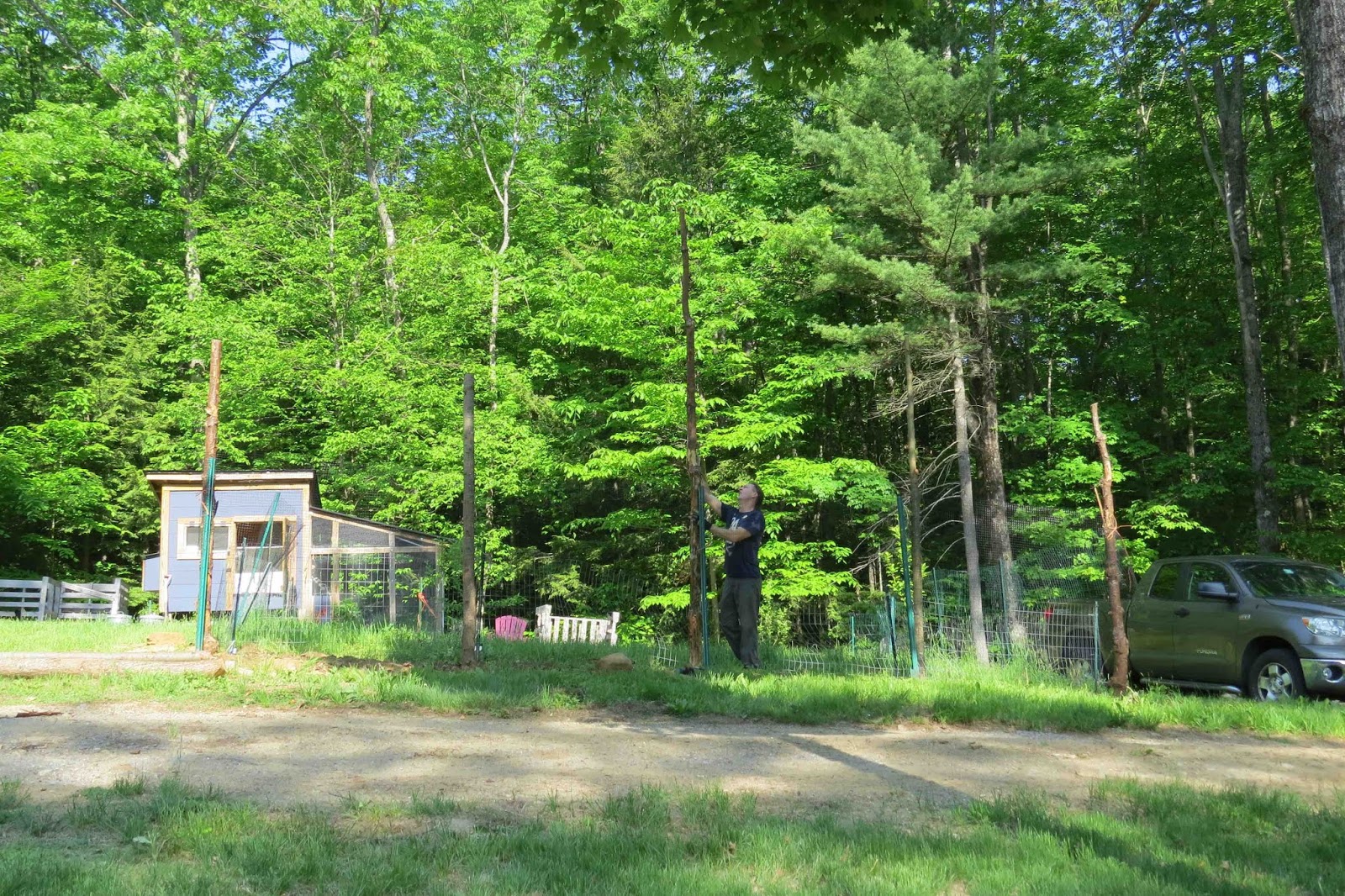
After losing four chickens to marauders last year I decided I needed to stop free-ranging and start pasturing my birds. In deciding how large an area to allow them I realized that the easiest thing was to simply enclose the fruit trees in a fence that would do double duty - protect the birds from snatch & grab foxes and the trees from deer. So we cut some pine trees to act as posts and planted them around the orchard.

Planting the posts
We didn't skimp on height figuring we could always chainsaw them shorter later on. I hadn't decided on what fencing I was going to use yet so didn't want to make the mistake of having the posts be too short.
I needn't have worried about height...
We scraped the ground in between the posts to make it easier to bury fencing later on and then did a bit of scorching on a couple posts to kill bugs and season it a bit. Just an experiment to see if it helps the poles last longer.
Adding flame
I ended up going with a poly fencing that's sold as deer protection. It's seven feet high and comes in 100 foot rolls for around $30. Nice price! And although it won't stop something chewing through it, it will stop something running through it (it's not deer netting which tears if you look at it funny, it's heavier than that). And remember - the chickens are safely in the coop at night; this is day-time protection from stuff that snatches them on the run (fox!). Anything that climbs can obviously get in, but that's not as likely when we, and Cooper, are running around outside.

I buried a foot of fencing and stapled the rest to the poles. I'll add cross braces soon.
Stomping down the buried fence
It took a lot of dirt to bury the fence
Cooper keeping cool
Here's a decent picture of the fencing. And the chickens hanging out with me inside the protected area. They love the space and the grass.
Heavy gauge poly fence
The first night the fence was in place something tried to dig under it and failed. Whatever it was did manage to chew a small hole that I fixed by weaving in wire. It didn't get in though, so that's good news.

Friday, June 15, 2018

The new chickens

I brought home the new batch of chickens on April 21st. I purchased them at Tractor Supply and they were roughly a week old. Hard to tell since they just kinda jumble them all together, but that's the best estimate we got.

We set them up in our big dog kennel placed in the utility room so they'd be warm. April weather is always unpredictable and this year was very cold out so I didn't want to put them up in the coop yet despite the fact that it's got power for the heat lamp. I just felt more comfortable having them in the house where I could keep an eye on them. This only worked because we didn't have cats at this point. Not sure what I'll do next time...

Welcome home
Cooper is extremely good with chickens. Not quite as good with chicks - they move too much like prey. So she was carefully supervised as we introduced them to her.
One very interested dog
 They're so little! And apparently, tired.
Boom, asleep.
The heat lamp provides a hot spot of around 95 degrees week 1 then you keep adjusting it 5 degrees downward each week of age. The thermometer was critical for tracking temperature and I raised / lowered the lamp depending on what they needed.
Comfortable arrangement, not too piled up, not too scattered
 They were wonderfully active little buggers.
Time stamp: 09:03:39
Who fell asleep at the drop of a hat.
Time stamp: 09:03:50
The grew up so quick!
One week later
And it didn't take long before they were trying to jump out of the kennel. An old window screen solved that issue.
Just over 3 weeks old
With the planned arrival of the new cats (and with warmer weather) I moved them out to the coop at about 4 weeks of age. The heat lamp is still be available to create a hot spot and they have the whole coop to explore, a big improvement in space over the kennel.

Bravely leaving the box
Didn't take long for them to leave the box and start to explore the new area. Lots of running from one side of the coop to the other.
Definitely a flock
Settling right in
Several weeks later, they're much bigger and have totally claimed the coop. Unfortunately they also decided that the nest boxes were awesome places to nap. That's a no-no. I've since covered the nest box opening with fabric so they can't get in there. When they're closet to 25 weeks of age and getting ready to lay, I'll open the boxes back up and put the golf balls in there as a lure. Worked great last time.
But we like it in here.
Probably aught to mention what type of birds I got. Three are Buff Orpingtons and three are Black Sex-Linked defined as a cross between Rhode Island Reds and Barred Rocks. Both types of bird are known as dual-purpose birds which means they are good egg-layers while still maintaining size/weight for eating. The plan, just as with my last birds, is to keep them for egg production a couple years and then harvest for meat. This time avoiding the fox, obviously. 

The birds are now about 8 weeks old and I'm getting gorgeous color variation on the Blacks, as you can see above. Can't wait to see what they look like when fully grown.